Visit Garryowen!

Friday, July 23, 2010

Grant Bull Tail

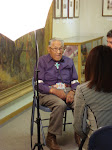
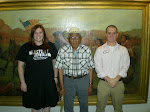
I just comepleted an interview with Grant Bull Tail, the great grandson of Come Up Red. Mr. Bull Tail provided the Custer Battlefield Museum with the oral history of his great grandfather, who was a Crow Indian that lived for one-hundred years.

Here is the link to the article, now posted on the Custer Battlefield Museum website:

http://www.custermuseum.org/Interns/Come%20Up%20Red.pdf


-Hayley

Wednesday, June 23, 2010

The Intern Reading List

I just wanted to share with you a few of the books that Kiley, Andrew and I have been reading here at the Little Bighorn. Hopefully, they will be useful for you as well. We sell all but one of these books in the museum.


Counting Coup: Becoming a Crow Chief on the Reservation and Beyond - Joseph Medicine Crow.
All three interns have read this one. It’s a great book not only because it depicts the life of Joe Medicine Crow, but it describes his assent to chiefdom, the Crow way of life, and Crow heritage.


In His Brother’s Shadow: The Life of Thomas Ward Custer - Roy Bird.
I am reading this one. I brought this book from my home in Kansas, where Mr. Bird resides and writes. It’s nice to get a glimpse at the other brother, who was just as accomplished a soldier as his famous sibling.


The Last Stand: Custer, Sitting Bull, and the Battle of the Little Bighorn - Nathaniel Philbrick.
This is the newest addition to the museum, and a book that Kiley is working through right now. This is a large, 417 page comprehensive work that is the newest literature on the battle. We also sell this book on audio CD too. Here is the a link to the New York Times review: http://www.nytimes.com/2010/06/04/books/04book.html?scp=1&sq=%22The%20Last%20Stand%22%20%22Kakutani%22&st=cse


Tatanka-Iyotanka: A Biography of Sitting Bull - Michael Crummet.
This is a relatively brief, comprehensive background on Sitting Bull’s life. All three of the interns have read this one.

George Armstrong Custer: A Biography - Mark L. Gardner.
Like the Sitting Bull biography, this small book is a good read for someone needing a detailed, yet brief account of Custer’s life and times. All three interns have read this book as well.

Custer’s Fall: The Native American Side of the Story - David Humphreys Miller.
This work is one of our best sellers. It is a book compiled of 72 Native American first-hand accounts of the Battle of the Little Bighorn. Kiley has just started this book.


The Girl He Left Behind: The Life and Times of Libbie Custer - Suzanne Middendorf Arruda.
I just completed this book. It’s a work on Libbie Custer’s life and times, mainly detailing her years spent on the plains with Custer.

My Life on the Plains: Or, Personal Experiences with Indians- General George Armstrong Custer.
Andy has just started Custer’s book. The book is compiled of Custer’s newspaper articles accounting his newly reorganized 7th Cavalry and their operation on the frontier between 1867-1869.

Wednesday, June 16, 2010

A Historical Evening

(Hayley, rolling out the hardtack)


Last night Chris invited us all up for a cookout. Hayley and I went into Hardin to the grocery store after we finished in the Museum to pick up some burgers, chips, and buns. To say the least, Andrew, Hayley, and I were all really excited to switch out our Subway sandwich for some burgers! We all enjoy Subway, but Andrew and I still have over two months to try every combination (just turkey if you’re Hayley!). After our cookout Chris decided it would be a good time to begin making hardtack for visitors to try as they entered the Museum. Hardtack is a snack, if I can even call it that, that soldiers use to take into battle with them because it virtually never went bad. It is made of flour, salt, baking soda, and water. Sounds good, right? While in army camps across the United States, men would eat hardtack as their meals. If the hardtack was too hard the men would just dip it in their coffee in order to soften it up, or to remove the worms that might be infesting it. As you can see why would we not want to try this? After all we are learning about every other part of the battle, why not the food they had to eat. Hayley, Andrew, and I took turns trying to roll out the hardtack so that we could cut it into small squares in order to bake. Chris even got his hands dirty, literally, trying to mix all the ingredients together. Now any recipe that calls for three ingredients and afterwards needs to sit out in the open air because cling rap or plastic bags would cause it to become moldy sounds pretty fool-proof, but we are pretty sure we might have overcooked it. I guess we will just have to see what our fearless visitors think tomorrow!

While waiting for our hardtack to cook, Chris decided to show us some of his collections of autographed documents and pictures he has up around his house. I would have been happy with just seeing the picture of John F. Kennedy at the beach, mobbed by a few dozen old ladies, and the signed document that went with it, but then Chris showed us documents and pictures he had signed of Nixon’s resignation, Ford’s pardon of him, and even an autograph letter of Albert Einstein! Thomas Edison’s letter about the first film camera had the best handwriting out of any influential historical figure I have ever seen. It was elegant and very pretty, although he may not have liked to hear that. After seeing a ship’s document signed by James Madison and then Secretary of State James Monroe, Chris showed us the real entertainment of the night….Elizabeth Custer’s manuscript collection! We got to look through some pieces of her collection that did not fit in with the rest of her letters. It was amazing to hold a piece of paper that she had actually written on and touched herself! Although some of her handwriting will take more than a few minutes to decipher, all that we could read immediately told as little pieces of her life that most people in this world do not know about. It was all so surreal.

Hayley here. I would just like to comment a bit further on the Libbie Custer documents that we got a chance to handle and read through last night. We saw some of Libbie’s most private documents, not because they were journal entries, but because they are the writings of her daily happenings, the witty quotes or poems or to-do lists that she had the inkling to scribble down. I believe that it is not always the heartfelt letters or journal entries that reveal Mrs. Custer, but instead the importance of small, quick notes and scribbles. And there are a lot of them. Libbie saved almost every piece of paper upon which she ever doodled. Some would like to call it hoarding, but I like to think of it as a woman with historical awareness. Researches desperately need people like Libbie Custer to record their lives for future prosperity. For her hoarding tendencies, I would like to say, from a historian-in-training: thank you Libbie Custer.

The Heritage Happenstance

Yesterday was an eventful day in the Museum. Not only did Hayley and I begin drawings and sketches on a new display pertaining to Custer’s Life Insurance Policy, but we also got the okay from Chris to switch up another display in order to show more about Libbie Custer. If creating our own displays in the museum was not exciting enough, while I was working I had “relatives” of Sitting Bull and Custer walk in right after one another. Usually I get a couple “relatives” a week, but I’ve never had two people come in almost at the same time. While I was checking in Custer, Sitting Bull overheard his announcement, and the two men went walking around the Museum together reminiscing about their supposed ancestors. At the risk of sounding too judgmental, I would believe some of these men if any were willing to show some proof. Even if these “relatives” are not really related to these two infamous men, their stories are always fun to listen to and who knows, I might have even learned a thing or two.

Monday, June 7, 2010

The new 2010 summer interns!

Hayley, Kiley, and Andrew here, the new interns for the summer 2010! The season has just kicked off, all of us arriving just within the last week or two. We have all unpacked, toured the museum and battlefield, and are ready for a summer of museum tourin' and history-havin' fun.

Kiley here now! The landscape of Montana is beautiful! It really is "Big Sky Country"; much different than what I am used to living on the East Coast. So far my favorite thing about Garryowen is where we are. We work and live on the exact same ground the Battle of Little Big Horn began. I could walk outside our room and possibly be standing in the same spot Sitting Bull might have stood over 100 years ago. The idea of being where he once camped is thrilling. For me this land, along with the artifacts in the museum, really help to bring history alive!

Hayley here. I have to agree with Kiley that my favorite aspect of the museum so far is being able to live where Sitting Bull camped, and where Reno first attacked the village. Inside the museum, I have been keeping my eye on the lock of Custer's hair (maybe I will get to see it even closer!). Our room is very comfortable, with photos of Libbie Custer and Sitting Bull looking over us at night.

Andrew here: My first day at Garryowen I got to experience how the Battle of the Little Big Horn is still used as a tool in the training of new generations of military officers. With the visit of a group of officer candidates from the Indiana National Guard, I was able to experience first hand how the lessons of Custer and the Little Big Horn are incorporated into the understanding of the modern battlefield.

Friday, September 11, 2009

In Memoriam

"A survey of the disastrous battleground disclosed a dreadful slaughter."

"The suffering was heartrending."

"It is true...it is no excuse for their treachery and atrocities."

"The situation now looks serious."

These quotes were published in newspapers and magazines in the year 1876 after the disastrous Battle of the Little Bighorn. The news reached Americans on a wide-spread scale during the nation's Centennial celebration - a time when Americans were revelling in their nation's strength and achievements. What a shock it was to realize that a country being lauded for its endurance had suffered such a severe blow.

We don't have to imagine the grief that every American experienced on that day in 1876. Just two months after celebrating the 125th Anniversary of the Battle of the Little Bighorn - proclaiming "Peace, Unity, Friendship" - that shock once again resonated across America on September 11, 2001 as we watched images we'll never forget, hearing comments as chilling as those above.

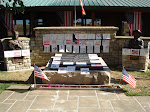
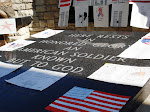
It is lamentable that such calamitous occasions should occur, but they reveal how we as a nation are unified throughout history. Just as we erected a memorial at Ground Zero, monuments and memorials dot the landscape of the Little Bighorn Battlefield, declaring America's resolution to never forget. One such monument is the Tomb of the Unknown Soldier at the Custer Battlefield Museum. The granite tomb holds the remains of an unidentified 7th Cavalry trooper, whose skeleton was found fifty years after the battle was waged. The tomb and peace memorial were dedicated during the Burying the Hatchet Ceremony, with White Bull Sioux Indian and General Godfrey performing the ceremony before thousands of observers.

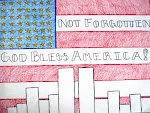
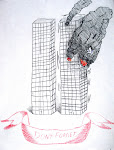
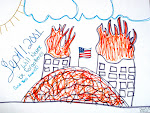
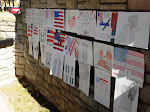
Today, the Battle of the Little Bighorn and the events of 9/11 came together at the Tomb of the Unknown Soldier, when students from Lodge Grass High School hung their 9/11-themed artwork on the monument. Forty-seven original creations adorned the tomb and peace memorial. Unlike the grave statements above, the students' words and images express reverence and a fresh hope:

"We remember."

"Not forgotten."

"United we stand."

"God bless America."

KB

Monday, August 31, 2009

Custer Battlefield Museum: 10 Little Known Facts

It is said that Lieutenant Colonel George Armstrong Custer is the most photographed/researched/written about man in history. Likewise, his Last Stand at the Battle of the Little Bighorn has drawn interest from hundreds, nay thousands, of individuals. This is part of the reason our director, Christopher Kortlander, decided to open a museum on the battlefield.

Those who choose to visit the Custer Battlefield museum will undoubtedly leave knowing more than they did when they entered. Working in the museum every day, I have had a unique opportunity to learn a lot about the battle, but my knowledge of the museum's exhibits has come to include some things that often go unnoticed.

1.) Of the ninety-some photographs lining the museum's walls, it is easy to miss seeing a few. One that I hope you don't miss seeing is Hairy Chin, of the Hunkpapa tribe, dressed as Uncle Sam. It never fails to bring a smile to my face.

2.) According to one of our exhibits, the name Hunkpapa means "those who camp at the entrance." Now I find this to be interesting, because in June of 1876, the Hunkpapa tribe was situated on the edge of the Indian Encampment in the valley of the Little Bighorn - the edge where Major Reno's column attacked, beginning the battle. Could it be that their name was prophetic? Or that they really did always situate themselves at the entrance to the camp?

3.) One of the Indian casualties of the battle was a Cheyenne named Roman Nose. What an interesting blend of cultures - a Native American with a name referencing an ancient culture, of which one presumes they only knew through their interactions with the White Man.

4.) Apparently the soldiers of the all-Black Ninth Cavalry were called Buffalo Soldiers by the Indians, because their hair resembled that of a buffalo. Now I've read several articles about the Buffalo Soldiers, but not one seemed to mention the origin of their nickname. Thank you, Custer Battlefield Museum, for clearing that one up for me.

5.) Sitting Bull - one of the most repeated names in the museum - is mentioned in the exhibits 30 times. Lending credence to my opening statement, Custer is referenced more than 100 times.

6.) A close examination of the museum's several oil paintings will prove to be enlightening and inspiring. However, Kirk Stirnweis' "They Died With Their Boots On" seems to be the most gruesome, featuring a soldier falling into death with an arrow in his throat and a man staring out of the canvas with one bulging eye - too uncannily like that video of the prairie dog on the Japanese game show. Don't know what I'm talking about? Look here: http://www.youtube.com/watch?v=y8Kyi0WNg40

7.) The museum's collection includes nigh a dozen pairs of moccasins. One, however, is missing a shoe lace.

8.) Custer always went into battle with his personal flag, sewn for him by his wife, Libbie. The Custer Battlefield Museum has a replica of this guidon, however, it has one flaw: it is missing Libbie's initials, which she stitched into one of the corners. To our credit, though, these initials were shot off the guidon before it even reached her husband.

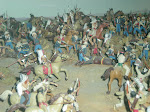
9.) In the diorama of the battle created by a high school class in 1976, one of the warriors appears to be pulling off the Matrix bullet-dodge move - and this before the technology seen in The Matrix was even dreamed of!

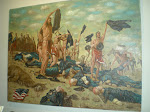
10.) The painting "Battle of Little Bighorn," by a European artist named Bergven, hangs on the museum's back wall and is covered in thick stains. I spent days lamenting the painting's poor quality of conservation, and then I realized it used to hang in a bar. The stains? Beer. The painting's quality? Inexplainably, yet quaintly, improved. KB

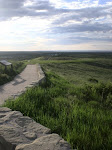
Follow the road to glory....

Follow the road to glory....

The View From the Outside Looking In

The View From the Outside Looking In

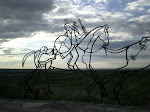
All the Pretty Horses

All the Pretty Horses

The First Visit to LBH NM

The First Visit to  LBH NM

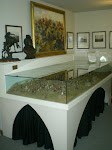
Battle Recreation Table

Battle Recreation Table

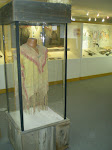
Ghost Dance Shirt

Ghost Dance Shirt

LBH Miniatures

LBH Miniatures
a close-up of the battle recreation

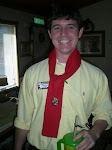
Custer's Cravat

Custer's Cravat
Somebody loves the cravat

Lewis and Clark

Lewis and Clark
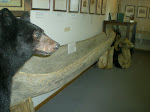
A bear, a 400-year-old canoe and a ram head, with one thing in common

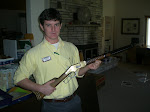
Justin and his gun

Justin and his gun
he is waaaay too excited about holding this gun

Search This Blog