



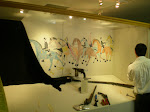
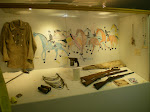


Howdy blog readers,
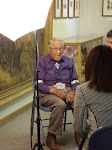
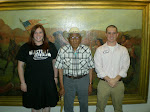
My name is Bart and I'm the latest intern to arrive at the Custer Battlefied Museum in Garryowen, Montana. I hail from Helix, Oregon and I'm currently studying Human Physiology at the University of Oregon in Eugene,OR. I'm super-excited to be here and I expect that there will be plenty of intersting adventures to share with you on this blog throughout the summer.
Saturday, June 16, 2012

Friday, June 15, 2012
History of the Cavalry in the U.S. Army!
The museum has been pretty full the last week or so, and many people are asking about the anniversary of the battle this year, which has been fun to talk about. Both Sarah and I have had some pretty in depth conversations with visitors about various topics of the battle, and we've been learning a lot in the process as well. In fact, one visitor I spoke to yesterday reminded me that it was the anniversary of the army (6/14/12) and I figured it would be interesting to talk a little about the beginnings of the Cavalry branch within the U.S. Army, which was prominent in the 18th-20th centuries, especially during the westward expansion.
 |
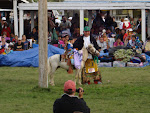
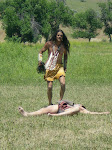
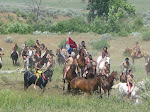
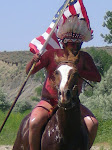
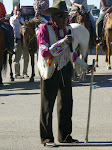
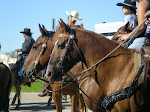
| Little Big Horn Battle Reenactment, Cavalry |
George Washington first saw the effect a small British cavalry unit had on his men at the Battle of White Plains, and asked Continental Congress for a small "dragoons" force in 1776, which was approved for 3,000 men. Congress appointed the Polish revolutionary soldier, Count Casimir Pulaski, to train them as an offensive strike force during winter quarters of 1777–78 at Trenton, New Jersey. After the Continental Army was discharged in 1783, the first cavalry unit to be formed was during the War of 1812, but it would eventually be disbanded after the war due to being too expensive to maintain in a standing army. The Westward Expansion of the early to mid 19th century would bring the cavalry forces into the spotlight once again, securing them a place in history during the Civil War and the Indian Wars. They began as Mounted Ranger Battalions protecting settlers among the East bank of the Mississippi River. To correct what was perceived as a lack of discipline, Congress formed the United States Regiment of Dragoons as a regular force in 1833. After infamous battles such as Little Big Horn with the 7th Cavalry and Custer's legacy forever attached to the mounted forces, they proceeded into the 20th century during World War I and even into World War II, until they merged with more mechanized regiments (tanks, heavy machinery, etc.) The last horse cavalry charge by an Army cavalry unit took place against Japanese forces during the fighting in the Bataan Peninsula in the village of Morong on January 16, 1942, by the 26th Cavalry Regiment of the Philippine Scouts.
I found it pretty interesting to see how the cavalry, and the Army, have progressed over the last 250 years or so. I'm glad that visitor reminded me of the anniversary, despite the vague idea I had, because much of this information I didn't know until I researched it. Thank you, visitors, for your little tidbits of knowledge! We love hearing them and can't wait to interact with more of you.
Posted by Christin Fimiani
Wednesday, June 13, 2012
The 7th Ranch RV Camp
After having a great time at the BBQ with the 7th Ranch work campers we decided to go up to the 7th Ranch ourselves and take a look around. The RV park is very easy to get to, when you exit at 514 you simply turn left, going under the freeway, and then follow the signs, which take you south down the frontage road until you get to Reno Creek, where you turn left again until you get to the beautiful 7th Ranch. We get visitors in the museum who are staying at the 7th Ranch and they have nothing but good things to say about the facility, which after taking a look myself, I have to agree with.
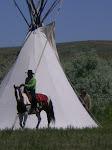
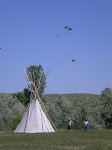
The setting is gorgeous with rolling, green hills on all sides and a wide, blue sky as far as the eye can see. The 7th Ranch not only offers full or partial service sites, with trees between the sites to give shade on sunny days, but also cabins and tepees for travelers without an RV or who are adventurous and want to experience a night in a tepee! For the comfort of their visitors they also provide laundry and bathing facilities with soft water, which is a luxury in this part of the country. Chip and Sandy are native Montanans and have owned the ranch for 20 years. They purchased the ranch from Henry Weibert, author of Sixty-Six Years in Custer's Shadow, who was happy to pass on his property to people who were as interested in its history as he was.
If you are interested in gaining more information about the 7th Ranch you can follow the link below to their website:
 |
| Follow this sign down the Frontage Rd |
After having a great time at the BBQ with the 7th Ranch work campers we decided to go up to the 7th Ranch ourselves and take a look around. The RV park is very easy to get to, when you exit at 514 you simply turn left, going under the freeway, and then follow the signs, which take you south down the frontage road until you get to Reno Creek, where you turn left again until you get to the beautiful 7th Ranch. We get visitors in the museum who are staying at the 7th Ranch and they have nothing but good things to say about the facility, which after taking a look myself, I have to agree with.
 |
| Full Service Sites |
 |
| Cabins and Teepes! |
You can also visit them on facebook for up to date reservation information and additional photos and videos:
Posted by Sarah Szabo
Friday, June 8, 2012
Visiting the National Monument and our BBQ!
 |
| Last Stand Hill, Little Bighorn National Monument |
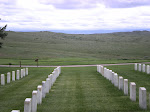
This week has gone by fast, but it's been packed with a lot of people at the museum! As Sarah said in the previous post, earlier this week Chris took us out to see where the unknown soldier was found as well as the battlefield and National Monument. We got a chance to walk through a part of the cemetery and see where Goes Ahead and Curley, two of Custer's scouts, were buried. Major Reno is also buried there and was the only officer from the battle to be buried in the cemetery with such high honors and an eleven gun salute. We got a chance to see the monument and Last Stand Hill where Custer and his men fell. The view from the top of the hill was incredible, but there was a somber mood throughout the area, despite the crystal clear morning. Seeing the markers on the hill allowed visitors to get a grounded view of what happened during the Battle of Little Bighorn, and envision it to the fullest extent. Across the road from the monument was the Indian memorial which was dedicated in 2003 in memory of all the tribes who died defending their way of life during the battle. It came to represent the mutual understanding of the infinite all the dead possess, both 7th Cavalry and Native American. Inside the memorial were beautiful displays dedicated to the Sioux, Cheyenne, Arapahoe and Crow Indians who lost their lives. We're hoping to get a chance to attend one of the Ranger talks and visit the battlefield again very soon.
 |
| Cutting the watermelon |
Yesterday we got to throw together a BBQ with Chris and invited a group from the 7th Ranch down to attend, along with a few other friends in the area. It was a lot of fun preparing the food and setting up, and it was a great chance to meet everyone and share experiences. Good food and great company always bring people together and this was no exception! Not to mention the delicious watermelon Sarah and I got to cut up for dessert, along with the New York style cheesecake our guests brought (which reminded me of home). Hopefully, we'll get a chance to throw another gathering later on in the summer. All in all, it's been a very productive week and we're looking forward to our new interns arriving and the reenactments soon to come.
Posted by Christin Fimiani
Tuesday, June 5, 2012
Previous Resting Place of our Unknown Soldier
 |
| Marker for Unknown Soldier |
Posted by Sarah Szabo
Saturday, June 2, 2012
Intern #2 has arrived!
My name is Christin (or Chrissy) and I'm from New Jersey, currently studying for my bachelor's degree in History (concentration in U.S. History) with an anthropology minor. It's been a beautiful first day here. Looking forward to spending the summer here in Garryowen!
Tuesday, May 29, 2012
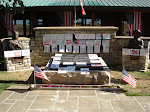
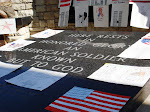
Memorial Day Weekend!
 |
| Flags flying in front of the Custer Battlefield Museum |
Here at the museum we did a steady business and had a tour group stop by, which was led by Neil Magnum, the former chief historian at the Custer Battlefield National Monument (that is what it was officially called when he was there - it was renamed Little Bighorn National Monument in the early 1990s). Mr. Magnum also wrote a book called "Battle of the Rosebud: Prelude to the Little Bighorn," which we sell in the trading post.
 |
| Me holding White Swan's gun |
As a special treat for the tour group Chris brought out White Swan's gun for them to hold and take pictures with. White Swan was one of Custer's Crow scouts who was with him at the Battle of the Little Bighorn. During the battle he was actually sent with Reno's Battalion and he was gravely injured during the battle. He was left deaf from a blow to the head and lame from a shot to the knee and hand. He did survive the battle with the assistance of his cousin Half Yellow Face who carried him out of danger and he went on to live for another 25 years.
I have never held a gun before and it was a lot heavier than I thought it would be, don't think I will be taking up shooting any time soon, but it was fun to hold something so old that was owned by such an interesting historical figure.
Subscribe to:
Posts (Atom)
Follow the road to glory....
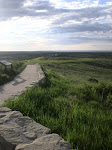
The View From the Outside Looking In

All the Pretty Horses
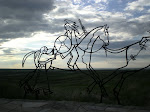
The First Visit to LBH NM

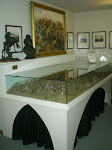
Battle Recreation Table
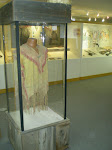
Ghost Dance Shirt
LBH Miniatures
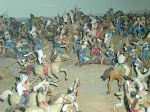
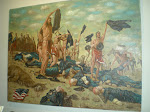
a close-up of the battle recreation
Custer's Cravat
Somebody loves the cravat
Lewis and Clark
A bear, a 400-year-old canoe and a ram head, with one thing in common
Justin and his gun
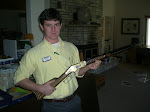
he is waaaay too excited about holding this gun